






May's birth flowers are the lily of the valley and the hawthorn, two blooms that arrive at the height of spring and carry associations with renewal, devotion, and quiet strength. The lily of the valley is recognized for its small, bell-shaped white flowers and its sweet, distinctive fragrance. It has long been connected to purity, the return of happiness, and sincere affection. The hawthorn, a flowering shrub or small tree that produces clusters of white or pink blossoms, represents hope, protection, and enduring love. Both flowers bloom naturally in May, and their pairing reflects the full character of mid-spring — a period of warmth, growth, and emotional openness. For anyone choosing flowers for a May birthday or exploring the meaning behind these blooms, understanding their symbolism adds depth and intention to the selection.
In This Article
WHAT IS MAY'S BIRTH FLOWER · THE MEANING AND SYMBOLISM OF LILY OF THE VALLEY · THE HISTORY OF LILY OF THE VALLEY · THE MEANING AND SYMBOLISM OF THE HAWTHORN · HOW LILY OF THE VALLEY AND HAWTHORN REPRESENT MAY · HOW TO CHOOSE MAY BIRTHDAY FLOWERS · MAY BIRTH FLOWER TATTOO IDEAS · FAQ · CONCLUSION
In this article, we will explain why May has two birth flowers, what each one symbolizes, how their colors and forms carry different meanings, and how to choose the right arrangement for a May birthday. Whether you are selecting a birthday bouquet or considering a tattoo design inspired by these flowers, this guide covers the key information about both blooms.
WHAT IS MAY'S BIRTH FLOWER

May's birth flowers are the lily of the valley and the hawthorn. These two blooms were chosen to represent the month because they reach their peak during mid-spring and reflect the season's themes of renewal, affection, and natural abundance. The lily of the valley is May's primary birth flower, while the hawthorn serves as the secondary flower.
The tradition of assigning two birth flowers to certain months allows for a broader range of symbolism. The lily of the valley represents purity, sweetness, and the return of happiness. Its small, bell-shaped blossoms and gentle fragrance reflect the idea that meaningful beauty often exists in quiet, understated forms. The hawthorn represents hope, protection, and lasting love. Its sturdy branches and clusters of delicate blossoms give it a character that combines resilience with tenderness. While April's birth flowers mark the first surge of spring and June's birth flowers signal the arrival of summer, May's pairing captures the fullest expression of the spring season.
This dual tradition provides flexibility when choosing a flower for someone born in May. The lily of the valley suits recipients who value sincerity and gentle warmth, while the hawthorn appeals to those who appreciate strength, tradition, and natural beauty.
THE MEANING AND SYMBOLISM OF LILY OF THE VALLEY

The lily of the valley's symbolism is rooted in purity, humility, and the return of happiness. In the language of flowers, lily of the valley communicates sweetness and sincere devotion, often interpreted as a quiet expression of love that does not seek attention. As a May birth flower, the lily of the valley reflects the emotional warmth that characterizes the heart of spring, when the natural world is in full renewal and gardens are coming alive with color and fragrance.
The color of lily of the valley blossoms influences their specific meaning. White varieties, which are the most common, represent purity, innocence, and sincerity. They are associated with new beginnings and are frequently chosen for weddings, baptisms, and ceremonies that celebrate fresh starts. Pink varieties, which appear in certain cultivated forms, carry associations with tenderness, romantic affection, and gentle love. Each color variation allows for a slightly different emotional tone when selecting lily of the valley for a gift or personal arrangement.
The flower's small size and distinctive fragrance contribute to its symbolic character. Unlike flowers that dominate an arrangement through height or vivid color, lily of the valley communicates through subtlety and scent. The fragrance is mild but immediately recognizable, and the flower's tendency to grow in low clusters close to the ground reinforces its association with humility and genuine affection rather than outward display. Because of their delicate stems and compact bloom size, lily of the valley are most effective when used in intimate arrangements, small nosegay bouquets, or as accent clusters within larger spring designs. They pair naturally with white blooms and soft greenery, which highlight their graceful form.
THE HISTORY OF LILY OF THE VALLEY IN CULTURE AND TRADITIONS
Lily of the valley has been admired and cultivated for centuries. In France, the flower is inseparable from La Fête du Muguet, celebrated every May 1st. On this day, friends and family exchange small bouquets of lily of the valley as a token of luck and happiness — a custom that began during the Renaissance when King Charles IX received a sprig as a charm for good fortune. The tradition continues today as a beloved national holiday, with markets and street vendors filling entire towns with the flower's sweet scent.
During the Victorian era, lily of the valley became one of the most important flowers in floriography, the practice of sending coded messages through flowers. Giving lily of the valley conveyed a message of "the return of happiness," and the flower was often exchanged between people who wanted to express renewed devotion or mark the start of a joyful chapter. This tradition helped cement the flower's reputation as a symbol of sincere, enduring affection.
Lily of the valley also holds significance in religious and royal traditions. In Christian symbolism, the flower has been associated with the Virgin Mary and used as an emblem of humility and spiritual purity. In modern history, the flower has appeared in some of the most notable royal weddings — Princess Grace of Monaco and Kate Middleton both included lily of the valley in their bridal bouquets, drawn to its association with purity and new beginnings. These varied cultural connections give lily of the valley a depth of meaning that extends across centuries and traditions.
In modern floral culture, lily of the valley remains a symbol of devotion and quiet elegance. While it is less commonly available as a year-round cut flower compared to roses or tulips, its symbolic significance and distinctive fragrance make it a meaningful choice for occasions that call for sincerity and understated beauty.
THE MEANING AND SYMBOLISM OF THE HAWTHORN

The hawthorn's symbolism centers on hope, protection, endurance, and sacred connection. It grows as a flowering shrub or small tree, producing clusters of white or pink blossoms in May that cover hedgerows and meadows with a soft, fragrant display. The hawthorn has been part of human culture for thousands of years, and its symbolic associations are among the richest of any flowering plant.
As a May birth flower, the hawthorn represents the protective and nurturing side of the spring season. While the lily of the valley speaks to gentleness and purity, the hawthorn carries a deeper message of resilience and spiritual significance. Its branches are often armed with small thorns — a natural metaphor for the idea that strength and tenderness can exist together, and that beauty sometimes requires protection.
The hawthorn holds deep spiritual significance in Celtic mythology, where it was considered one of the most sacred trees. Celtic traditions held that hawthorn trees marked the boundary between the physical world and the fairy realm, and they were often found growing near holy wells and ancient meeting places. Cutting down a hawthorn was considered extremely unlucky, and solitary hawthorn trees in fields were left undisturbed out of respect for the spirits believed to inhabit them.
Christian tradition also gives the hawthorn symbolic weight. Many accounts associate hawthorn with the crown of thorns, linking the tree to themes of sacrifice, endurance, and faith. The Glastonbury Thorn, a famous hawthorn tree in England, has been connected to the story of Joseph of Arimathea and has been a pilgrimage site for centuries. Beyond mythology, hawthorn has long been used in herbal medicine. Its berries and blossoms are known for their heart-supporting properties and are still used in tinctures and teas today. This practical healing tradition reinforces the hawthorn's symbolic role as a protector and sustainer of well-being.
HOW LILY OF THE VALLEY AND HAWTHORN REPRESENT MAY

Together, the lily of the valley and hawthorn capture the dual character of May. The lily of the valley represents the month's soft, fragrant, and emotionally open side, while the hawthorn reflects its capacity for strength, protection, and deep-rooted tradition. May sits at the center of spring — after the tentative beginnings of March and April but before the full warmth of summer — and both flowers align with this moment of confident, generous bloom.
The connection between May's birth flowers and the month's zodiac signs further illustrates this pairing. Taurus, which covers the first three weeks of May, is associated with loyalty, practicality, and an appreciation for beauty and comfort. The lily of the valley, with its understated elegance and enduring fragrance, corresponds to these traits. Gemini, which begins in the final week of May, is associated with curiosity, adaptability, and emotional expressiveness. The hawthorn, with its complex symbolism and connection to both physical and spiritual traditions, reflects the depth and versatility of this sign.
When used together in an arrangement, lily of the valley provides fragrance, delicacy, and intimate scale, while hawthorn branches add structure, texture, and a sense of natural wildness. This combination works particularly well for May birthday designs because it reflects the full range of qualities associated with the month — from gentle sweetness to quiet resilience.
HOW TO CHOOSE MAY BIRTHDAY FLOWERS
Choosing flowers for a May birthday should account for the recipient's preferences, the relationship between sender and recipient, and the setting where the flowers will be received. May is also the month of Mother's Day, which can influence availability and pricing for certain flower varieties, so planning ahead is advisable for birthday deliveries during the middle of the month.
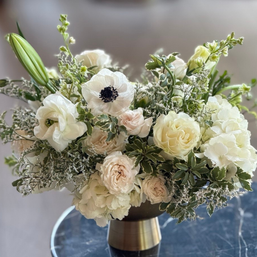
For recipients who appreciate fragrance and delicacy, arrangements that incorporate lily of the valley or similar bell-shaped flowers create an intimate, memorable gift. Because fresh lily of the valley can be seasonal and limited in availability, florists sometimes substitute similar white blooms like ranunculus or stock in white and cream shades to capture the same soft aesthetic. Pairing these with peonies in blush or pale pink creates a lush, spring-forward arrangement that feels personal and seasonal.
For recipients who prefer arrangements with more visual texture and natural character, incorporating hawthorn-inspired elements — branching stems, airy blossoms, and mixed greenery — adds dimension. Garden roses, spray roses, and flowering branches work well alongside spring foliage to create designs that feel collected from a garden rather than assembled from a catalog.
The format of the arrangement should match the occasion and setting. A hand-tied bouquet suits personal celebrations, while a structured arrangement in a vase works well for home delivery. For same-day flower delivery in Los Angeles, orders placed before the afternoon cutoff ensure timely arrival, though ordering a day ahead is recommended during Mother's Day week to secure the preferred delivery window.
DID YOU KNOW
In France, the tradition of giving lily of the valley on May 1st dates back to 1561, when King Charles IX received a sprig as a good-luck charm. He enjoyed the gesture so much that he ordered lily of the valley to be given to all the ladies of the court every May 1st thereafter. The custom spread throughout French society and continues today — on La Fête du Muguet, street vendors across the country are given special permission to sell the flowers without a license.
MAY BIRTH FLOWER TATTOO IDEAS AND MEANINGS

May birth flower tattoos are a popular way to represent a connection to the month or to honor someone with a May birthday. Because May has two birth flowers, tattoo designs can feature lily of the valley, hawthorn, or both flowers combined. For a broader overview of floral tattoo symbolism, the guide on flower tattoo meanings and designs covers additional options beyond birth month flowers.
Lily of the valley tattoos are often rendered in a fine-line style that emphasizes the flower's delicate, arching stems and small bell-shaped blooms. A single stem with cascading bells makes a fitting design for placements such as the wrist, ankle, or inner forearm. The simplicity of the flower's structure allows for designs that remain clear and legible at smaller sizes, and the addition of the plant's broad, curved leaves adds visual balance to the composition.
Hawthorn tattoos typically feature the flower's branching form, clusters of five-petaled blossoms, and in some designs, the characteristic thorns and small red berries. The natural complexity of the hawthorn lends itself to more detailed, structured designs that work well on the forearm, upper arm, or ribcage. Watercolor-style renderings that blend white and pink tones with green foliage capture the hawthorn's springtime appearance. Combined designs that pair a detailed hawthorn branch with a delicate spray of lily of the valley create a balanced composition that reflects both the strong and gentle aspects of the May birth flower pairing.
FAQ
Why does May have two birth flowers?
May has two birth flowers to represent the different qualities associated with mid-spring. The lily of the valley symbolizes purity, sweetness, and the return of happiness, while the hawthorn represents hope, protection, and enduring love. Together, they capture both the gentle and resilient aspects of the month's character.
What does lily of the valley symbolize as a May birth flower?
Lily of the valley symbolizes purity, humility, and the return of happiness. Its small, bell-shaped blooms and sweet fragrance reflect the idea that genuine beauty and affection often exist in quiet, understated forms. In the Victorian language of flowers, giving lily of the valley expressed sincere devotion and renewed joy.
What is the difference between lily of the valley and hawthorn in terms of meaning?
Lily of the valley communicates inner qualities such as sweetness, purity, and gentle devotion. Hawthorn expresses outward qualities including hope, protection, and spiritual resilience. The lily of the valley speaks softly, while the hawthorn stands firm. Together, they represent a balance between tenderness and strength that defines the May birth flower pairing.
How long does lily of the valley last as a cut flower?
Cut lily of the valley typically lasts between four and seven days in a vase. Keeping the stems in clean, cool water and placing the arrangement away from direct sunlight and heat sources helps maintain the blooms. Because the flowers are small and delicate, they benefit from a shallow vase that supports the stems without crowding the bells.
Can lily of the valley and hawthorn be combined in one arrangement?
Yes. Lily of the valley provides fragrance and intimacy at the base of an arrangement, while hawthorn branches add height, texture, and a natural, garden-gathered quality. Because fresh hawthorn is not always available through standard florists, designers sometimes use flowering branches like spirea or cherry blossom as substitutes that carry a similar aesthetic. Adding seasonal greenery completes the spring look.
What are the best flowers to pair with lily of the valley for a May birthday?
Lily of the valley pairs well with peonies, garden roses, ranunculus, and sweet pea for May birthday arrangements. White and cream-toned flowers create a clean, cohesive look alongside the lily's white bells, while adding touches of blush pink or soft lavender introduces warmth without overpowering the delicate primary flower.
Is lily of the valley safe to handle?
Lily of the valley is toxic if ingested by humans or pets, so arrangements should be placed out of reach of children and animals. Handling the flowers for arranging purposes is generally safe, though washing hands afterward is advisable. The toxicity does not affect the flower's fragrance or its suitability for display — it simply requires awareness about placement in the home.
CONCLUSION
The May birth flower pairing of lily of the valley and hawthorn reflects the sweetness, strength, and quiet devotion that define the heart of spring. The lily of the valley brings fragrance, purity, and centuries of association with happiness and sincere love, while the hawthorn adds structure, resilience, and a symbolic connection to protection and hope.
Choosing between a lily of the valley–inspired arrangement and one built around hawthorn elements depends on the recipient's preferences and the tone of the celebration. Both flowers are at their peak during May, and arrangements made during this month can incorporate white and cream tones alongside soft pinks and spring greens that feel distinctly seasonal. Whether sent as a birthday bouquet or used as inspiration for a personal tattoo design, May birth flowers offer a meaningful way to honor someone during one of the year's most generous and beautiful months. For additional guidance, the complete birthday flowers guide covers options for all occasions and preferences.


